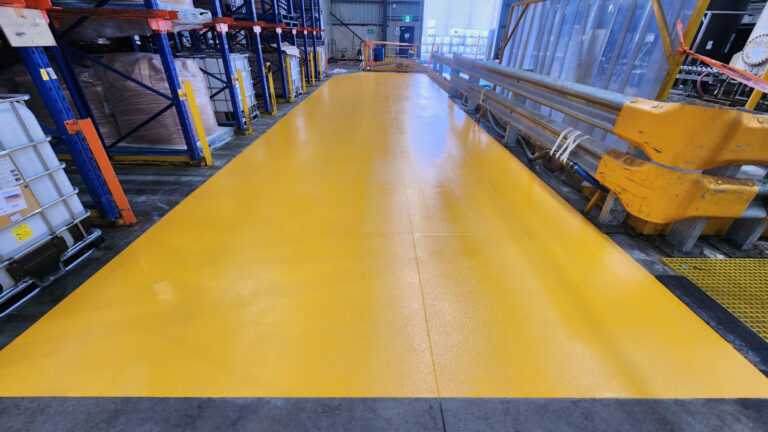

A Decision Framework for Performance, Risk & Long-Term Value
Warehouse flooring is not decorative. It is operational infrastructure.
It supports forklift movement, pallet racking, heavy equipment, and daily logistics activity. When flooring fails, it doesn’t just affect appearance, it affects safety, downtime, compliance, and operating costs.
The challenge is that “epoxy flooring” is often treated as a single product category. In reality, there are multiple systems designed for different levels of load, traffic, moisture exposure, and chemical resistance.
Choosing the right system isn’t about picking the thickest coating or the cheapest quote. It’s about aligning the flooring system with how your warehouse actually functions.
Below is a practical framework to help decision-makers evaluate the right epoxy flooring solution.
1. Traffic Intensity & Load Pressure
The first variable to consider is how your warehouse floor is used daily.
Ask:
- How many forklifts operate each day?
- What type of wheels are used (polyurethane vs steel)?
- What is the static load under racking systems?
- Are heavy items dropped or dragged across the floor?
- Are there high-turn zones where forklifts pivot repeatedly?
Light-duty epoxy systems may perform well in low-traffic storage environments. However, under heavy forklift traffic, thinner coatings can wear prematurely, leading to surface abrasion and eventual failure.
Heavy-duty industrial epoxy systems are designed for:
- High compressive strength
- Impact resistance
- Abrasion resistance
- Repetitive traffic zones
If your warehouse experiences continuous forklift movement, specifying a light system to save upfront cost often leads to rework within a few years.
👉 Related: Commercial & Industrial Epoxy Flooring Systems – https://homeconcretesolutions.com.au/commercial-industrial/
2. Moisture & Slab Conditions
Moisture is one of the most overlooked risks in industrial epoxy flooring.
Concrete slabs naturally release moisture vapour over time. If that vapour becomes trapped beneath an epoxy coating, it can cause:
- Bubbling
- Blistering
- Delamination
- Peeling
Many epoxy failures are not product failures, they are moisture management failures.
Before specifying a system, consider:
- Is the slab new or existing?
- Was a vapour barrier installed beneath it?
- Has moisture testing been conducted?
- Is the warehouse located in an area prone to high groundwater levels?
Where moisture risk is present, moisture-tolerant primers or vapour barrier systems may be required before applying the main epoxy layers.
👉 Deeper explanation: Moisture Under Concrete – The Hidden Cause of Epoxy Delamination
Skipping moisture testing to reduce upfront cost can significantly increase long-term risk.
3. Chemical Exposure & Environmental Conditions
Warehouses vary widely in environmental exposure.
Consider:
- Are oils, solvents, or cleaning chemicals used?
- Are there frequent washdowns?
- Is the space temperature-controlled?
- Is food storage or processing involved?
Standard epoxy systems provide general protection, but chemical-heavy environments may require specialised chemical-resistant systems.
In food-grade or hygienic facilities, seamless systems are often preferred to minimise bacterial harbourage and improve cleanability.
Selecting a coating without accounting for chemical exposure can lead to surface softening or discolouration over time.
4. Slip Resistance & Workplace Safety
A warehouse floor must balance durability with safety.
High-gloss epoxy may appear smooth and clean, but in environments exposed to water, dust, or oil, slip resistance becomes critical.
Slip-resistant systems can include:
- Textured aggregates
- Quartz broadcast systems
- Flake-enhanced surfaces
- Adjustable slip ratings depending on zone
However, higher texture levels may impact cleanability, so the correct slip profile must match the operational environment.
👉 Related: Slippery Warehouse Floors? How to Improve Safety Without Replacing Concrete
A properly specified anti-slip system reduces incident risk without compromising operational efficiency.
5. Concrete Condition & Surface Preparation
Even the best epoxy system will fail if applied to poorly prepared concrete.
Key considerations include:
- Surface contamination (oil, grease, curing compounds)
- Existing coatings
- Cracks and joint movement
- Uneven or deteriorated surfaces
Mechanical grinding is typically required to create a suitable surface profile for epoxy to bond correctly.
This process:
- Removes laitance
- Opens the surface pores
- Ensures strong mechanical adhesion
Acid etching alone is often insufficient for industrial applications.
👉 Learn more about preparation standards: https://homeconcretesolutions.com.au/concrete-grinding-preparation/
Surface preparation is not a minor detail, it is foundational to performance.
6. Downtime & Operational Continuity
Installation planning plays a major role in system selection.
Warehouse managers often need to consider:
- How long the facility can tolerate downtime
- Whether installation can be staged in sections
- Cure time before forklift traffic resumes
- Night or weekend installation options
Some heavy-build systems may require longer cure times. Planning installation in operational phases can reduce disruption.
👉 Related: Minimising Downtime: Installing Epoxy Flooring in an Active Facility
Flooring should enhance operations, not interrupt them unnecessarily.
7. System Types & Performance Expectations
Epoxy systems can broadly be grouped into three categories:
Standard Multi-Coat Epoxy
- Suitable for light to medium traffic
- Cost-effective
- Smooth finish
- Moderate lifespan
Epoxy Flake System
- Enhanced slip resistance
- Visually uniform finish
- Hides minor imperfections
- Often used in mixed commercial spaces
Heavy-Build Industrial Epoxy
- Thicker application
- High impact resistance
- Designed for heavy forklift use
- Longer service life under stress
The right choice depends on operational intensity, not aesthetics alone.
8. Cost vs Lifecycle Value
Commercial flooring decisions should not focus solely on cost per square metre.
Consider instead:
- Expected lifespan
- Maintenance intervals
- Downtime cost if failure occurs
- Recoating cycles
- Risk exposure
A lower-cost system that fails in three years often costs more over a ten-year period than a properly specified system installed once.
👉 Further reading: Repair, Recoat or Replace? A Cost Comparison for Industrial Floors
Flooring is an operational investment, not just a surface upgrade.
Final Consideration: Matching the System to the Operation
The right epoxy flooring system is not defined by:
- The highest gloss level
- The lowest quote
- The thickest coating
It is defined by alignment:
- With traffic intensity
- With environmental exposure
- With moisture risk
- With safety requirements
- With long-term operational planning
When those variables are assessed correctly, epoxy flooring becomes a durable, predictable asset within the warehouse, not a recurring problem.